

Are These Three ‘Vertical’ Software Stocks AI-Proof?
nCino, Procore and Veeva target niche verticals with strong growth – but AI agent adoption poses a risk to the vertical SaaS model.

After a rocky June, there were signs towards the end of the month that investors are starting to pull capital out of artificial intelligence (AI) chip and infrastructure stocks and into the AI software theme.
The iShares Expanded Tech-Software Sector ETF [IGV] rose 4.06% on 26 June, while the iShares Semiconductor ETF [SOXX] fell 5.64%. However, this does not mean rotation is fully underway. IGV has fallen 6.16% in the past month, whereas SOXX has risen 9.84% in the same time period.
For investors, finding value in the crowded software as a service (SaaS) space can be a challenge. While some analysts will be sounding the death knell for SaaS stocks, others are more bullish.
Brent Thill, Managing Director for Software and Internet Research at Jefferies, said in May that value can be found in software companies carving out a niche for themselves serving a single sector, as opposed to ‘horizontal’ software companies – those whose products can be used across multiple industries.[1]
“They are building vertical models for healthcare, government, retail and automotive. We think that if you speak the language of those industries and integrate AI into a workflow, there is an incredible opportunity ahead,” said Thill.
Data crunched by industry publication SaaS Mag shows that ‘vertical’ software has slowly been gaining ground on horizontal software over the past several years, its market size growing at a faster annual rate since 2020, as seen in the graph below.[2]

We take a look at three software stocks that have carved out a niche in different verticals: nCino [NCNO], Veeva Systems [VEEV] and Procore Technologies [PCOR].
NCNO, PCOR and VEEV serve the finance, construction and life sciences verticals
nCino offers a cloud-based operating system – built on Salesforce [CRM] – used by a range of financial institutions, banks and credit unions. Its software helps with customer onboarding, loan origination and compliance workflows.
Procore provides software to the construction industry. Its platform connects those on construction sites with teams in the office, helping to track and manage construction projects and reduce the risk of bottlenecks and delays.
Veeva has built cloud-based software for the life sciences industry. Its range of tools includes clinical data management, customer relations and quality control. The company was originally using Salesforce, but switched to its own proprietary platform, Veeva Vault, with the split being finalised in September 2025.
As French consulting firm Capgemini said at the time: “The Veeva-Salesforce split is more than just an IT migration – it is an opportunity for life sciences companies to rethink their HCP engagement strategy and evolve into a customer-centric enterprise capable of delivering hyper-personalised, omnichannel experiences at scale.”[3]
A miserable year for NCNO, PCOR and VEEV
NCNO stock rose 8.92% on 26 June, while it has declined 2.74% in the past month. The share price is down 39.04% since 1 January.
PCOR stock rose 9.43% on 26 June, though it is down 10.54% in the past month. The share price has slumped 42.38% year-to-date.
VEEV stock rose 8.40% on 26 June and is up 6.99% in the past month. The share price has fallen 23.24% since the start of the year.
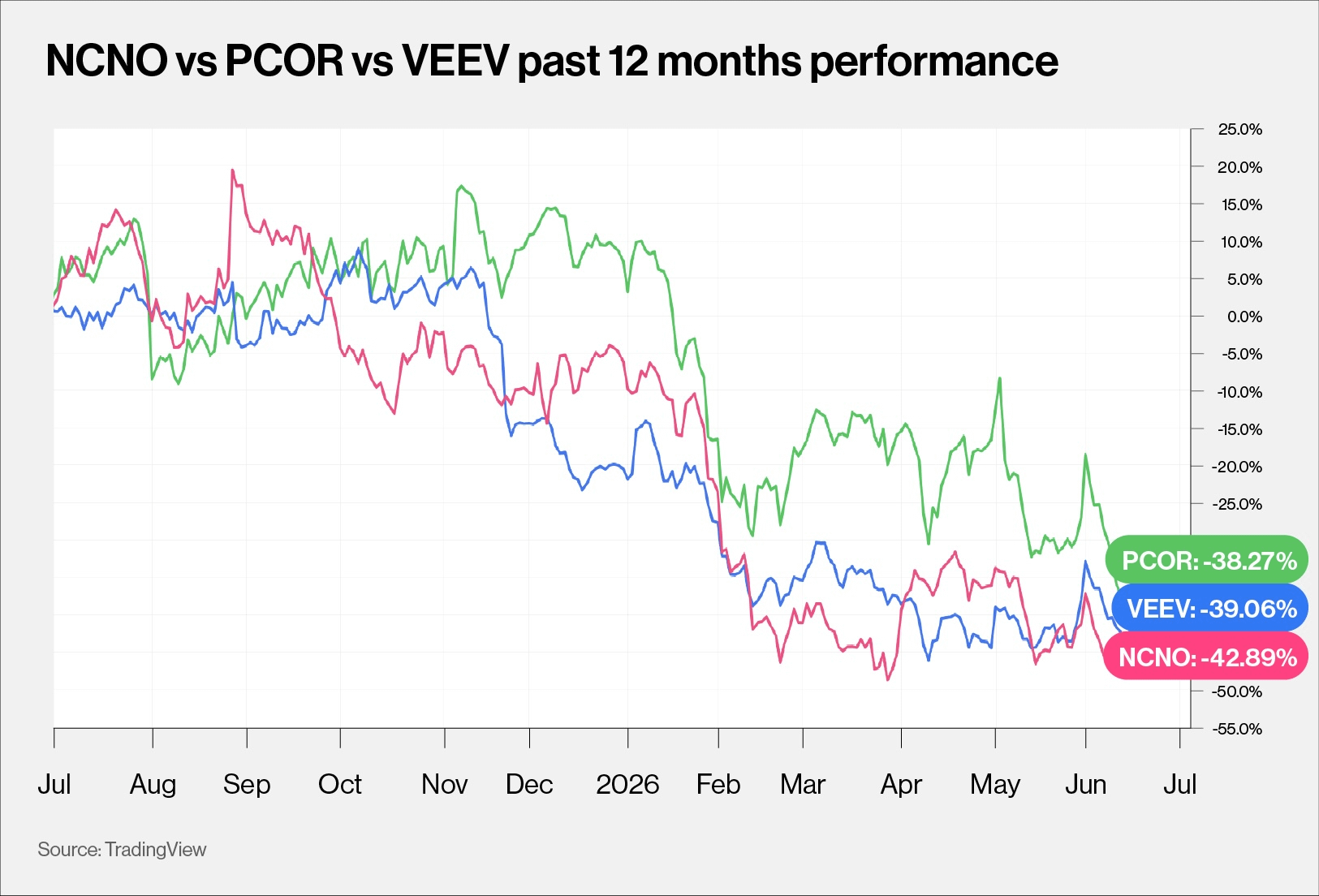
Vertical software earnings show strength
nCino reported its fiscal Q1 2027 on 27 May. Total revenue was up 11% year-on-year to $159.4m, including a 12% rise in subscription revenue to $140.9m.[4] Guidance for the current quarter is for total revenue to be in the range of $157.75m-159.75m, compared with $148.8m reported in Q2 2026.[5]
“Our customers continue to validate our AI product strategy and are demonstrating their confidence in nCino as their long-term technology partner,” nCino CEO Sean Desmond said in the earnings release.
Procore reported its Q1 2026 earnings on 5 May. Total revenue came in at $359m, up 16% y/y, with the number of customers contributing at least $100,000 in annual recurring revenue also growing by 16%.[6] Total revenue for the current quarter is expected to be in the range of $364m-366m, compared with $324m in Q2 2025.[7]
“That performance, which exceeded the high end of our guidance, gives us even more confidence in the future, enabling us to increase our full-year outlook. I am particularly pleased that we have also strengthened our flagship platform, as well as our agentic AI capabilities,” Procore CEO and President Ajei Gopal, said in the earnings release.
Veeva reported its fiscal Q1 2027 earnings on 3 June. Total revenue came in at $882.9m, up 16% y/y, including a 15% rise in subscription revenue to $730.2m.[8] Total revenue for the current quarter is expected to be in the range of $902m-905m, compared with $789.1m in Q2 2026.[9]
“Our rapid progress with Veeva AI sets the foundation as we enter the next chapter of our industry cloud. We are moving from an industry-specific application company to an industry-specific application and AI agent company,” Veeva CEO Peter Gassner said in the earnings release.
Here is how the current fundamentals of NCNO, PCOR and VEEV compare.
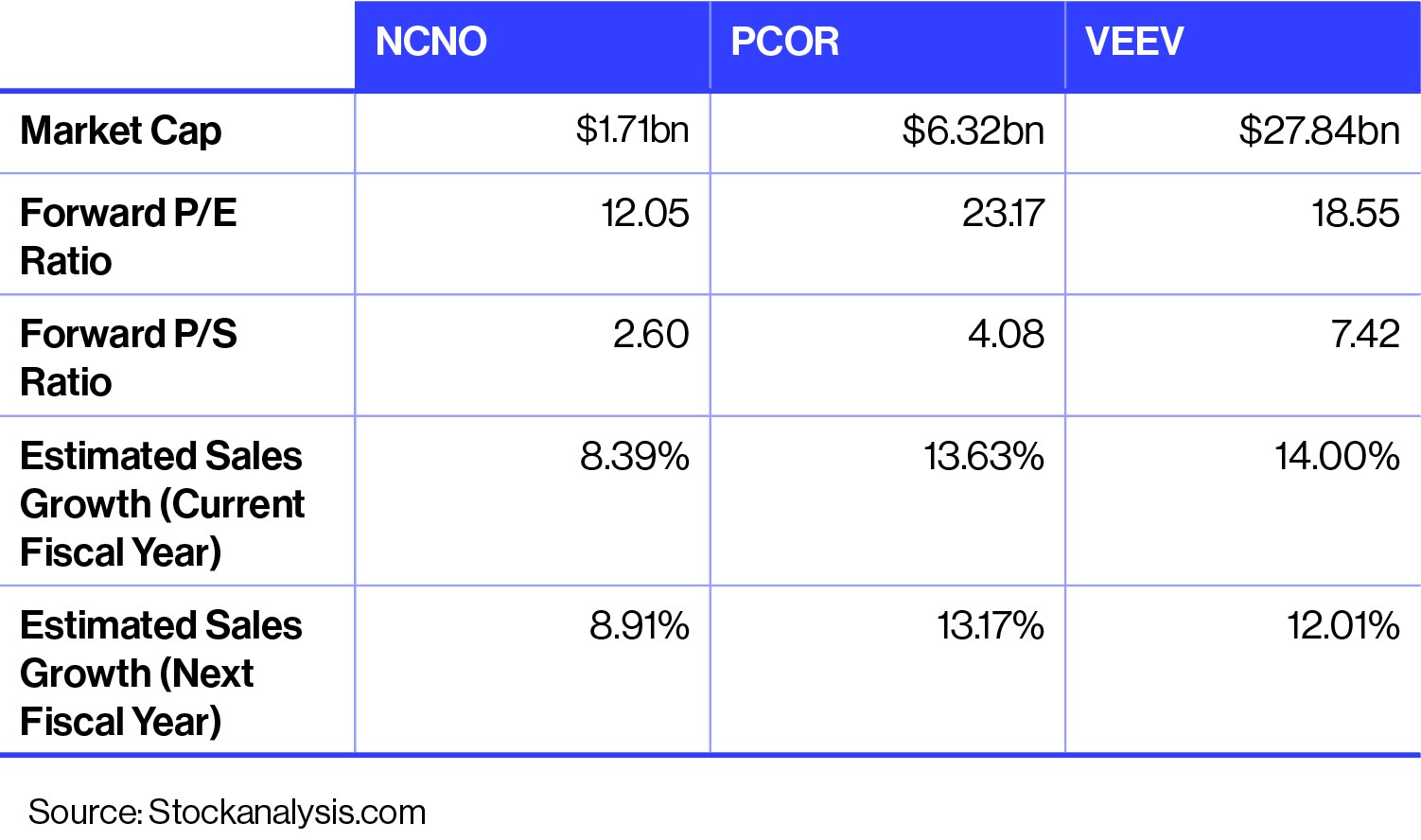
While all three of NCNO, PCOR and VEEV stock could be considered overvalued based on their forward P/E ratios, their current levels could be a good buying opportunity given the steep sell-off this year.
Vertical software: The investment case
The bull case for vertical software
Verticals such as construction, finance and life sciences remain plagued by fragmented, legacy IT systems despite broader investment in AI and R&D. This means there is plenty of room for nCino, Procore and Veeva to continue to grow their customer bases.
The bear case for vertical software
As AI agents become more advanced and accessible, there is the possibility that more companies will build their own rather than buy from software providers.
Analysts at Citizens slashed their price target for NCNO stock by approximately 28%[1] in May for these exact concerns following nCino’s nSight conference. Discussions with attendees have led the analysts to believe that some banks may put the brakes on AI spending as they work out the best way forward.[10]
Conclusion
While AI valuation concerns continue to hang over the market, the software companies with longevity will arguably be those that are building products for specific verticals.
nCino, Procore and Veeva are three to keep an eye on, especially if a full rotation out of semiconductors and into the software theme gets underway.
This is for informational purposes only. CMC Markets UK Plc does not recommend any specific securities or investment strategies. Investing involves risk and investments may lose value, including the loss of principal. Past performance does not guarantee future results.
[1] https://www.jefferies.com/insights/markets/softwares-road-back/
[2] https://www.saasmag.com/vertical-saas-outperforming-horizontal-2026/
[3] https://www.capgemini.com/wp-content/uploads/2025/07/CRM-platform-evaluation-and-selection-in-Life-Sciences.pdf
[4] https://investor.ncino.com/news-releases/news-release-details/ncino-reports-first-quarter-fiscal-year-2027-financial-results
[5] https://investor.ncino.com/news-releases/news-release-details/ncino-reports-second-quarter-fiscal-year-2026-financial-results
[6] https://investors.procore.com/news/news-details/2026/Procore-Announces-First-Quarter-2026-Financial-Results/default.aspx
[7] https://investors.procore.com/news/news-details/2025/Procore-Announces-Second-Quarter-2025-Financial-Results/
[8] https://ir.veeva.com/news/news-details/2026/Veeva-Announces-Fiscal-2027-First-Quarter-Results/default.aspx
[9] https://ir.veeva.com/news/news-details/2025/Veeva-Announces-Fiscal-2026-Second-Quarter-Results/
[10] https://www.investing.com/news/analyst-ratings/citizens-cuts-ncino-stock-price-target-to-23-on-ai-concerns-93CH-4695670