


Key Takeaways
As AI moves into the real world, Ambarella, Cognex and Teradyne offer three distinct ways to gain exposure to physical AI, spanning edge computing, machine vision and robotics.
Recent developments include NXP’s reported talks to acquire Ambarella, Cognex’s new Nvidia-powered vision platform and Teradyne’s 33% growth in robotics revenue.
The humanoid robotics market could potentially reach $40bn by 2035, but physical AI remains an emerging theme and adoption could take time.
“The ChatGPT moment for physical AI is here – when machines begin to understand, reason and act in the real world.” So said Nvidia [NVDA] CEO Jensen Huang in January 2026, announcing his firm’s new Alpamayo platform, an open-source suite of Vision-Language-Action models, tools and datasets designed to accelerate the development of artificial intelligence (AI) for autonomous vehicles.[1]
“Robotaxis are among the first to benefit,” Huang said. “Alpamayo brings reasoning to autonomous vehicles, allowing them to think through rare scenarios, drive safely in complex environments and explain their driving decisions – it’s the foundation for safe, scalable autonomy.”
But was this release really the ChatGPT moment for physical AI? There is certainly a strong case that Alpamayo represents an important milestone, particularly because it moves AI beyond perception and prediction towards reasoning and action in a physical environment. But physical AI is a much broader opportunity than autonomous driving.
One of its most exciting frontiers is humanoid robotics. As the graph below illustrates, rapid advances in AI are making machines increasingly capable of perceiving, reasoning about and interacting with the physical world.
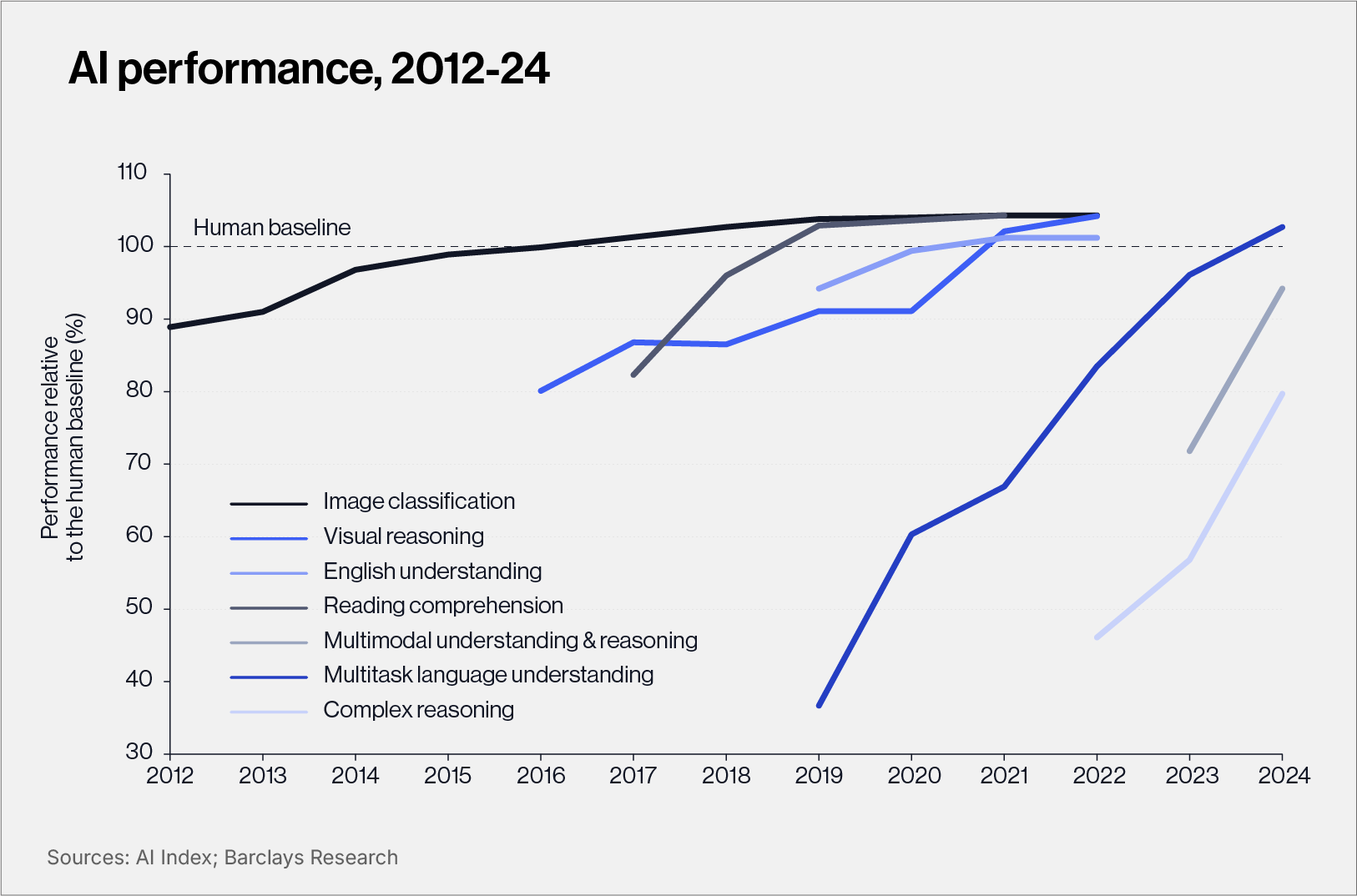
The convergence of increasingly capable AI models, simulation and cheaper hardware is opening the door to a new generation of robots that can operate in factories, warehouses and eventually homes.
Yet the evidence suggests that physical AI more broadly has not quite reached its ChatGPT moment. The humanoid robotics sector remains relatively small today, at around $2bn-3bn, but its growth potential is substantial. One base-case forecast sees the market reaching $40bn by 2035, while more bullish scenarios envisage a market of up to $200bn.[2]
For investors, this raises an interesting question: if the first phase of AI created enormous demand for compute and data centres, where will the value accrue as AI starts to interact with the physical world?
Whereas the initial boom centred largely on software and the hyperscalers providing the necessary computing infrastructure, this phase is likely to bring physical hardware into sharper focus, according to a recent report from Barclays Research. This could create opportunities further down the supply chain, particularly for manufacturers of actuators, precision components and other technologies needed to turn AI models into physical machines.
This analysis examines three stocks that occupy precisely that position in the supply chain: Ambarella [AMBA], Cognex [CGNX] and Teradyne [TER].
AMBA: The edge AI play
Ambarella is a US-based semiconductor design company specialising in low-power, high-definition video compression and image processing.
One of its areas of focus is edge AI, the technology that enables AI models to run locally on devices, rather than relying entirely on cloud data centres, reducing latency and connectivity requirements. It is a key enabler of physical AI, allowing robots, autonomous vehicles and other machines to process sensor data and make decisions in real time.
Its latest results were encouraging: Q1 FY2027 revenue rose 17% year-on-year to $100.4m, while non-GAAP net profit reached $5m, compared with $3m a year earlier. Automotive revenue hit a record, driven by AI adoption in commercial vehicles and safety applications, while management highlighted growing opportunities in robotics and edge infrastructure.
The company guided for Q2 revenue of $105m-111m and non-GAAP gross margins of 59-60.5%.[3] Its next results are due on 3 September 2026, after the market close.[4]
Perhaps the most significant development in recent times has been the news, reported by the Financial Times on 31 July, that NXP Semiconductors [NXPI] was in talks to buy Ambarella.[5] While there has been no public confirmation of a deal, the news alone strengthens the investment case for AMBA stock, demonstrating that a major automotive semiconductor player sees strategic value in Ambarella’s edge-AI capabilities.
CGNX: The machine vision play
Cognex develops machine vision systems that give factories and robots the ability to “see” and analyse their surroundings. Its latest results – released on 5 August – showed strong momentum, with Q2 revenue rising 17% y/y to a record $291m and adjusted EPS jumping 80% to $0.45. Management also highlighted AI-enabled vision and data centre growth, while guiding for Q3 revenue of $300m-320m.[6]
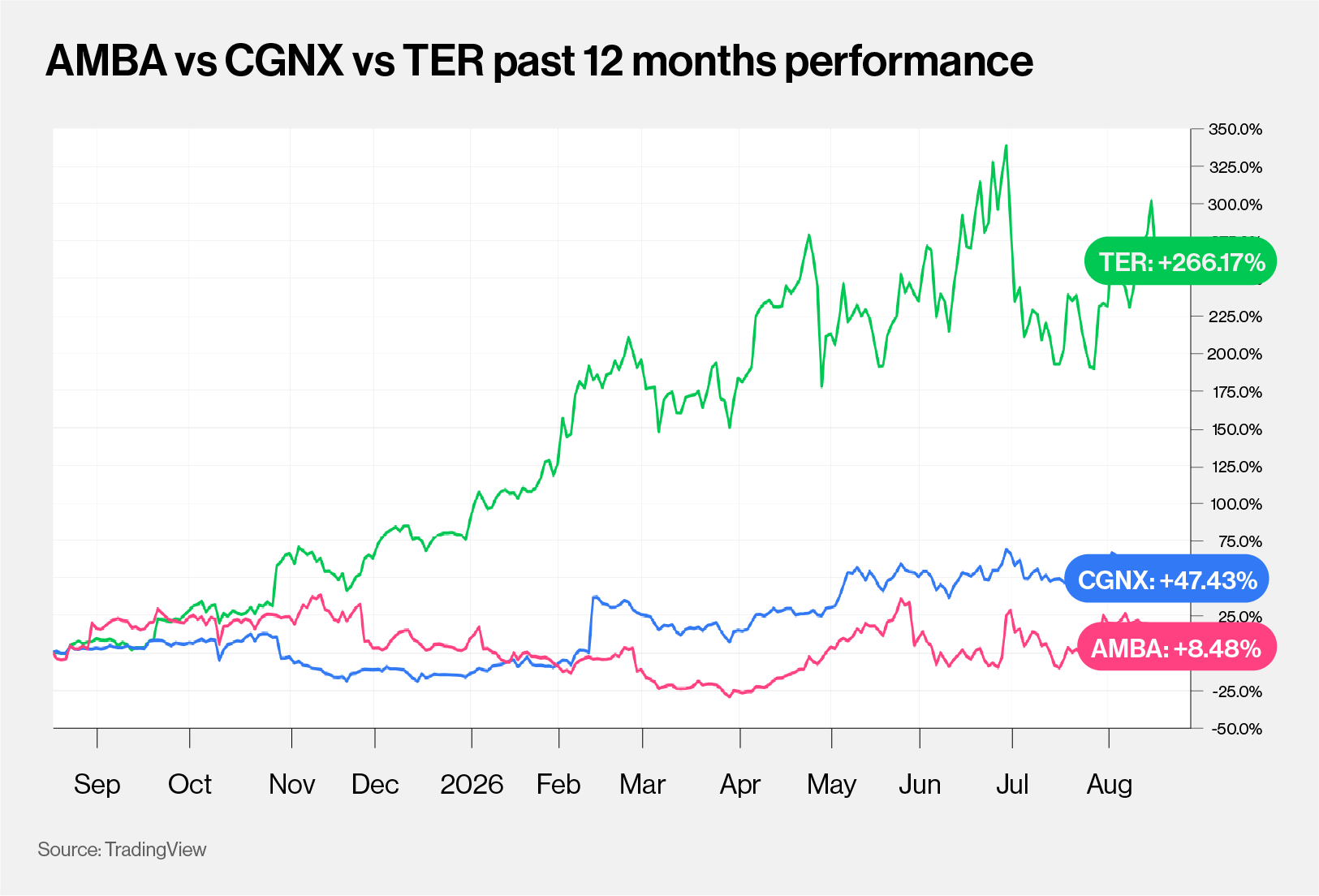
The earnings gave a boost to a stock that was already performing well: CGNX is up more than 76% year-to-date.
During Q2, Cognex partnered with Nvidia [NVDA] to launch an AI vision platform. The In-Sight 6900 is a new modular machine-vision controller aimed at manufacturers looking to run more demanding AI workloads directly on factory equipment. Powered by Nvidia’s Jetson, it can process AI applications at the edge without requiring an external PC while allowing manufacturers to configure cameras, optics and lighting to suit specific inspection tasks.[7]
The firm also worked with Qualcomm [QCOM] to launch the In-Sight 3900 Vision System on 5 May 2026. This high-performance edge AI system is powered by Qualcomm Dragonwing platforms, offering ultra-fast, high-resolution industrial machine inspections directly on the factory floor.[8]
These two partnerships highlight the growing convergence of machine vision, edge AI and industrial automation – as well as Cognex’s position at the forefront of this development.
TER: The one-stop-shop automation play
Teradyne combines two businesses that give it exposure to both the AI semiconductor boom and the automation of the physical world. It is a leading supplier of automated test equipment for semiconductors, while its robotics division includes collaborative robot maker Universal Robots and autonomous mobile robot specialist Mobile Industrial Robots.
Its latest results were particularly strong. Q2 revenue more than doubled y/y to $1.33bn, comfortably beating expectations, while adjusted EPS rose to $2.47 from $0.57. Semiconductor Test accounted for $1.12bn of revenue, reflecting strong AI-related demand, while Robotics revenue increased 33% to $100m.[9]
The robotics business is becoming increasingly relevant to the physical AI story. Teradyne says AI-related revenue now represents 15% of robotics sales, while Universal Robots has been expanding its AI capabilities and Teradyne recently showcased production-ready physical-AI applications.[10]
Management expects Q3 revenue of $1.2bn-1.3bn and adjusted EPS of $1.85-2.15, with AI-related demand remaining robust. That makes Teradyne an unusual way to play physical AI, offering exposure not only to robots themselves but also to the semiconductor infrastructure required to build increasingly intelligent machines.
The investment case for physical AI stocks
This is how the three currently compare in terms of fundamentals.
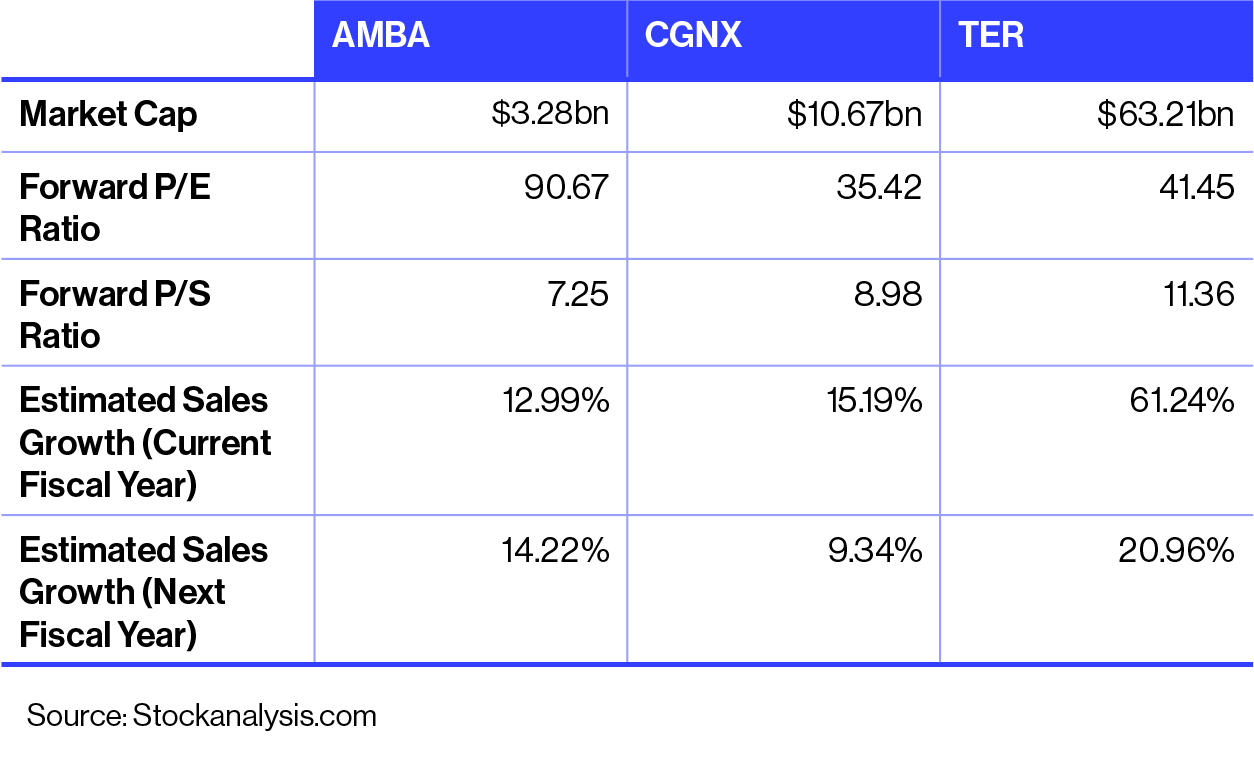
The stocks covered here offer different ways to gain exposure to the emerging physical AI opportunity.
Ambarella is arguably the most direct edge AI play, with its chips allowing machines to process visual information and make decisions locally. The potential NXP acquisition also suggests that its technology has real strategic value.
Cognex offers a more established industrial AI proposition, providing machine vision technology that allows factories and robots to interpret their surroundings. Its strong earnings and partnerships with Nvidia and Qualcomm point to growing demand for AI-enabled inspection.
Teradyne provides the broadest exposure, combining semiconductor testing, collaborative robots and autonomous mobile robots. Its robotics division is smaller than its semiconductor-testing business, but growing rapidly and increasingly incorporating AI.
None of the three is a pure-play humanoid stock, but that is arguably the attraction: each provides exposure to the infrastructure required as physical AI moves from prototypes towards commercial deployment.
Conclusion
Physical AI may not yet have reached its ChatGPT moment, but the foundations for a major new phase of AI investment are being laid. Ambarella, Cognex and Teradyne offer three distinct routes into that theme, spanning edge computing, machine vision and robotics, with recent earnings and partnerships providing evidence that demand is already emerging. If AI’s next chapter is about machines that can perceive, reason and act in the physical world, these three companies could be among the beneficiaries.
This is for informational purposes only. CMC Markets UK Plc does not recommend any specific securities or investment strategies. Investing involves risk and investments may lose value, including the loss of principal. Past performance does not guarantee future results.
[1] https://www.forbes.com/sites/kristinshaw/2026/01/06/nvidia-unveils-ai-advancements-it-calls-its-chatgpt-moment/
[2] https://www.ib.barclays/our-insights/series/impact-series/ai-gets-physical-innovation-meets-opportunity.html
[3] https://ambarella.gcs-web.com/news-releases/news-release-details/ambarella-inc-announces-first-quarter-fiscal-year-2027-financial
[4] https://investor.ambarella.com/news-releases/news-release-details/ambarella-announces-second-quarter-fiscal-year-2027-earnings
[5] https://www.ft.com/content/f02ce02b-fa33-49ad-b8c7-81ab5cec3de0?syn-25a6b1a6=1
[6] https://www.prnewswire.com/news-releases/cognex-reports-second-quarter-2026-results-302844140.html
[7] https://www.cognex.com/en/company/press-releases/in-sight-vision-controller-powered-by-nvidia
[8] https://www.cognex.com/en/company/press-releases/in-sight-3900-high-performance-ai-vision-system
[9] https://investors.teradyne.com/news-events/press-releases/detail/445/teradyne-reports-second-quarter-2026-results
[10] https://finance.yahoo.com/technology/ai/articles/teradyne-drives-robotics-growth-ai-161600901.html